DVD - £9.99 - 
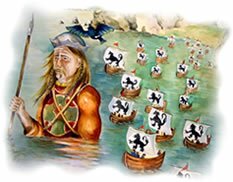
On the high rock of Harddlech, Bendigeid-Fran (Bran the Blessed), a man of great stature and King over the Island of the Mighty, one day sat watching the sea.
Pwyll rode towards a grassy clearing and came apon a dead stag surrounded by small but fiery hounds: their coats were a blinding white, and their ears like glowing red coals. Bravely, the Prince urged his horse into the glade, charged wildly at the dogs and scattered them away.
As his own pack returned and grouped around the deer, a huntsman rode out from the trees and hailed him: "Lord, I will not greet you because you have driven off my hounds from their prey".
At these words the Prince promised to make up for his discourtesy. "Well" said the stranger "This is how to win my friendship. I am Arawn, King of Annwn (the Other World), and I have a neighbour called King Hafgan who is forever causing trouble. Yet whenever I hit him more than one stroke, the next day he is as well as he was before."
THE END
Copyright
ValleyStream 2004
Illustrations by Alexandra Davies

Storyteller - Cybi the Monk
Before The Lord of the Rings there was THE MABINOGION. Widely recognized as the finest arc of Celtic mythology, the eleven stories were preserved in two Welsh collections, The White Book of Rhydderch (1300-1325) and The Red Book of Hergest (1375-1425), though the stories themselves hail from an oral tradition dating back a thousand years. At its core are tales of heroes and men, birth and death, gods and beasts, penance and vindication, kinship and kingship, battles and quests. THE MABINOGION embraces much of ancient and early British culture, combining the numinous world of Celtic mythology, Arthurian legend and feudal Europe’s Age of Chivalry. Indeed, scholars have identified that it was out of THE MABINOGION that the Arthurian legends were born.
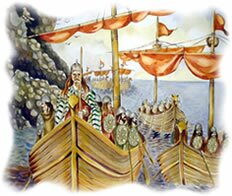
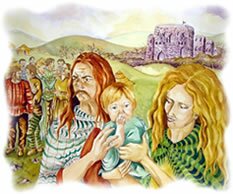
Towards him on the tide came 13 sailing ships, the shields of their men-at-arms upturned in gestures of peace. In the lead ship was Matholwch, King of all Ireland, who had come to ask for the hand of Branwen, fair sister of King Bran.
The British king agreed, and the wedding took place at Aberffraw on Anglesey. But it was held undercover of silken tents since Bran was so mighty a man that no house could contain him.
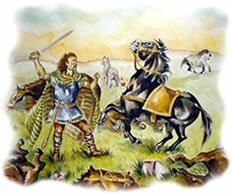
Now one of Bran’s brothers, called Efnisien, was full of mad tricks and hot temper. He had not been consulted about his sister's wedding, and when he chanced apon the Irishmen’s horses Efnisien slashed them with his sword, from their noses to their tails, in order to cause trouble.
King Bran tried to placate Matholwch: ‘To atone, I shall replace all your maimed horses with healthy ones. Furthermore, I shall give you a cauldron of rebirth: throw your dead warriors into its depths, and they shall be whole and hale on the morrow’. Accepting this, Matholwch and Branwen departed with their gifts to Ireland.
At first all went well, and a son was born to the couple. But in the second year rumours spread about Efnisien’s villainy, so that Matholwch was laughed at behind his back and derided to his face.
Fearing his court's ridicule, he avenged himself on his wife: she was forced to work in the kitchens, and the cook had orders to box her ears every day.
In secret Branwen reared a starling and taught it to recognise her brother. Then she fastened a letter under the bird’s wing and sent it flying towards Wales.
At Caernarfon the bird discovered the King. Incensed, he mustered a large army and a fleet of many ships and set off for Ireland. Yet, since Bran was so mighty a man that no ship could contain him, he waded across the sea.
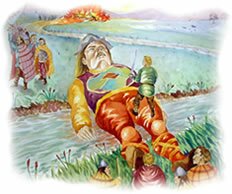
As the King strode towards Ireland, Matholwch and his men retreated beyond the River Llinon, burning down the bridge behind them. But Bran said: ‘Let him who leads, be a bridge’, and he stretched himself across the river so that his army could march over him.
Quickly, the Irishmen hatched a plan: they would promise to invest Branwen’s young son, Gwern, with the sovereignty of Ireland in the presence of her brother. What's more, they would build a great hall especially for the ceremony since the king was so mighty a man that (until now) no house could contain him.
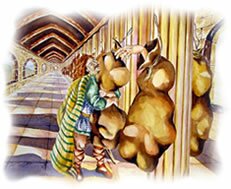
This idea pleased Bran, and building began. However, the Irishmen also prepared a trap. On both sides of one hundred pillars within the hall a sack was hung concealing a warrior in waiting.
Efnisien came in first - but he knew that old trick! And he squeezed the sacks containing every assassin till not one was left alive.
Then both nations entered the hall and sat down, each to one side. But when Gwern met his new relatives he was slow to greet Efnisien, whose warm blood had not been cooled by the sea-journey. Efnisien caught up his nephew and tossed him into the fire.
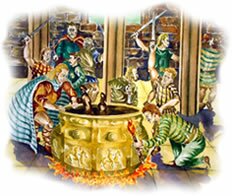
At once every man drew his sword and leapt into battle. The Irishmen dragged in the cauldron of rebirth and lit a fire under it, so that their dead warriors (when thrown into it) would be whole and hale on the morrow.
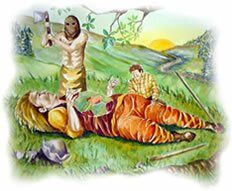
Efnisien saw this, and (full of remorse) he played his last joke. By lying down amongst the Irish bodies, he too was cast into the cauldron. He stretched himself out, the iron pot burst asunder - and his heart burst open.
To the Island of the Mighty only Branwen and seven sound men returned. Branwen broke her heart in despair, and she was buried on Anglesey beneath a standing stone on the banks of the Afon Alaw.
During the battle King Bran's foot had been stabbed by a poisoned spear. As he lay dying he bid his attendants: ‘Cut off my head and bury it on the White Mount of London, facing towards France. Whilst it remains there, no harm shall come to the Island of the Mighty from across the sea’.
And that is why, even today, birds are kept at the Tower of London (bran means crow in Welsh) in accordance with the prophesy of King Bran. For without them, the White Tower and the British monarchy will fall.