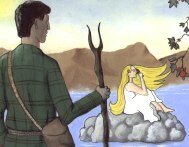
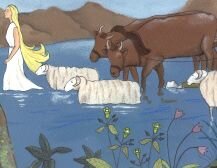
Beside the small lake beneath the red rocks of the Black Mountain grew the greenest grass on the whole mountainside. One morning, as usual, a farm lad brought his cattle up from the Myddfai Valley to graze.
But this day was special. In the midst of the blue waters sat a fair maiden combing her long blonde hair. So beautiful was she that the boy decided to win her, and he offered up the barley bread which his mother had made for his lunch.
But the maid turned away and called out: "Cras dy fara. Nid hawdd fy nala". ("Hard is thy bread. It's not easy to catch me".) Then she dived beneath the surface of the lake.
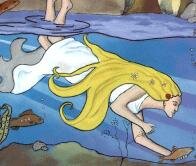
Next day the youth returned to the mountain, and there was his golden girl, tickling the fish in the middle of the lake. This time he waded into the water and held out unbaked dough.
Once again she refused it: "LLaith dy fara. Ti ni fynna". ("Soft is thy bread. I will not have thee"), and she vanished once more beneath the blue waters. The ripples spread out in all directions, and the fish darted away.
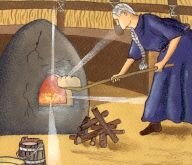
Sadly, the boy returned to the farmhouse and begged his mother's help. "Well" she said "if I make you a loaf that is neither too hard nor too soft, then surely even she will take it."
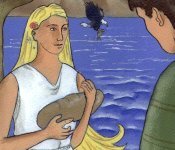
On the third day the golden girl accepted both the lad's bread and his hand in marriage. However, she warned him: "Strike me but three blows without just cause and I will return to my watery home".
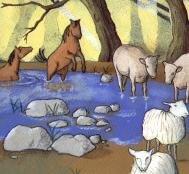
For the bride's dowry as many fine cattle, sheep, goats and horses trotted out of the lake as she could count without drawing breath. The animals followed the young people down to a new life in the valley.
All began well. With good weather and good livestock, the farm of Esgair Llaethdy prospered. The farmer and his wife were as happy as two people could be, and in time three sons completed the family.
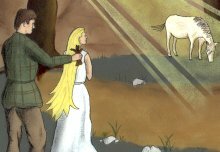
Then one day, late and disorganised, the couple set out for a christening. The wife seemed unwilling to go but she undertook to fetch the horse whilst her husband ran back for her gloves.
Yet when he returned the horse was still free, and he slapped a glove on his wife's shoulder. She sighed "Remember my warning to you. Take care, for that is the first blow struck without good cause".
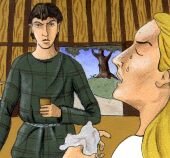
For years all continued well. Until, that is, the day of a wedding. Amongst all the wining and feasting, dancing and singing the golden lady turned her face to the wall and began to weep.
The farmer tapped her shoulder, complaining of tears amongst such cheerfulness. "I was crying for the troubles that lie ahead of this pair" she replied "and beware for that is the second blow".
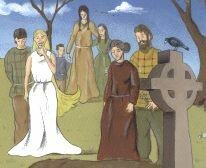
Still all went well. At last they attended a funeral. In the midst of black clothes and sad faces the wife began smiling behind her hand and then laughing out loud.
Once more, the startled husband patted her shoulder. "I was laughing because the dead are free of trouble" she cried "but alas you have forgotten my warning - that is the third blow struck without good cause".
At once she returned to their farm and called out to their animals, each one by name. Then she headed for the mountains, although the farmer followed after her and pleaded with her to remain.
Into the blue lake went the lady, with the cattle, sheep, goats and horses trailing behind her. Even four oxen dragging a plough disappeared under the surface, leaving a deep furrow on the lakeside which can still be seen today.
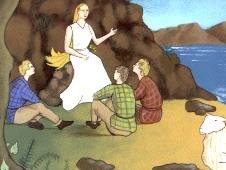
The three boys did meet up with their mother, and she taught them the healing qualities of plants growing on the mountains. In time they became the famous "Physicians of Myddfai", and their descendants had the power of healing too.
Although the farmer often looked for her he never did see his wife again, and in Llyn y Fan Fach, the small lake beneath the red rocks of the Black Mountain, the golden lady remained.
* THE END *
Copyright ValleyStream 99