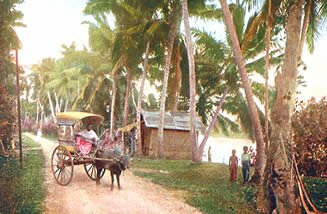
Gypsy travels
The earliest history of the Gypsy is traceable through an Arab historian; he related that 10,000 Indian dancers and musicians were brought to the court of the Shah of Persia (Iran) in 420 AD. During the following centuries these people were then moved on (both willingly or by force) through most of the Arab countries, North Africa, Greece and the Ottoman Empire around the Mediterranean Sea.
Gypsy traits as we know them now were visible then. By 1050 in Constantinople (Istanbul) they were noted as being fortune-tellers, acrobats, metal-workers, musicians and animal-tamers. In 1322 an Irish pilgrim wrote of a nomadic people living in Crete: "They rarely or never stop in one place beyond thirty days but always wander and flee as if accursed by God, and after the thirtieth day they remove themselves from field to field with their oblong tents, black and low, and from cave to cave". 
Gypsies served as soldiers and craftsmen in the Ottoman army, and they went with it as the Ottoman Empire expanded into Eastern Europe during the 14th century. From there, they dispersed into the rest of Europe, Britain and beyond, reaching Russia and Scandinavia by the end of the 16th century. Four Gypsies even sailed to Trinidad with Columbus when he went on his third voyage to the New World in 1498.
By the end of the 19th century they had also travelled to (often transported to) Australia, Canada, and North and South America.
There are now roughly 12 million Gypsies worldwide. In 1971 the First World Romani Congress was held in London, and the word Roma (meaning people in Romani) was adopted as the official name of the Gypsies.
British Gypsies
 Gypsies probably crossed over to Britain during the 15th century. The first record is from 1505 when Count Antoine Gagino of Little Egypt turned up on a Scottish ship bound for Denmark. Within a few decades these "outlandish people, calling themselves Egyptians" were being expelled by Henry VIII.
 Currently, there are about 2/300,000 Gypsies and other Travellers living in Britain. The groups in each country call themselves by different names, and figures for them are probably under-estimates. The Kale of Wales may number 2,000, and the Romanichals of England 65,000. Fewer Gypsies ventured to Ireland and Scotland, and in both countries there were plenty of itinerant people already. As such, the Minceirs of Ireland (30,000) and Nachins of Scotland (20,000) do not claim to be of Gypsy origin. Fairground people number about 25,000, and New Age Travellers 15,000.
Famous Gypsies
Well known people with Gypsy forebears include:
Saint Mother Teresa
Singers Elvis Presley, David Essex
Actors Charlie Chaplin, Michael Caine, Bob Hoskins, Yul Brunner, Rita Hayworth
Musician Django Reinhardt
Footballer Eric Cantona
Author John Bunyan
Victorian explorer Richard Burton.