For a few decades (though it seemed like an age) the Norman conquerors of Britain had been in charge, taking the best land and the favours of their King.
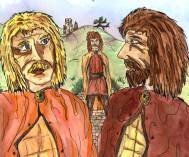
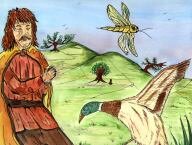
One winter's day two tall Norman knights, Milo (Earl of Hereford) and Fitz-John (Lord of Ewyas), strolled along the shore of Llyn Syfaddan near Brecon. Sandwiched between them, Gruffydd ap Rhys, son of the soil and natural heir to South Wales, strode to keep up.
Over the Welshman's head the Earl of Hereford spoke to his fellow: "I've heard that in Wales people believe a born ruler can command the birds to sing. If our friend here will oblige us, perhaps we can learn whether it is true or not".
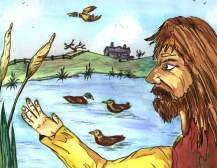
Now Gruffydd had also heard this folktale but he'd never seen it put to the test. He looked at the waterfowl on the lake: geese, swan and all varieties of duck. Each bird was busy - preening, sleeping, splashing its companions, or fishing the waters beneath its feet.
"Well" said the Prince "You, my friends, have taken control of this land. Perhaps it is you who can make the birds sing."
With much laughter, the Normans agreed to a competition. They didn't really think that they would succeed but they didn't think the Welshman would either.
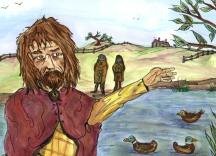
First Earl Milo tried. Approaching the bank, he entreated the birds pleasantly (in his best and most courteous French) to sing. They took no notice and carried on dabbling and diving as before.
Then Milo used a strong masterly tone. A few duck swam just a little nearer and then started weaving in and out of each other. The Earl complained that they made him feel dizzy and, I'm sorry to say, he started swearing at them. Still they made no sounds, only raised their bottoms at him or looked at him out of the corners of their eyes.
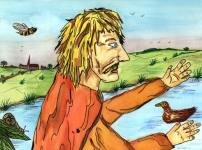
The Lord of Ewyas tried next and in a different fashion. Standing right on the lake's edge, Fitz-John began singing himself, in a high pitch, to encourage the waterfowl. Some of them glided silently towards him, expecting breadcrumbs.
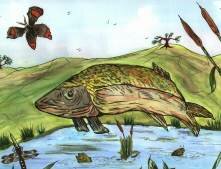
After that, he sang deeply (from the bottom of his chest) and waved his arms in an attempt to conduct them. At this, the birds scattered, flying back to the safety of their flocks, and a large pike leapt out of the water and bit the noble lord on his toe.
It was Gruffydd's turn. Calmly, he knelt on the ground and faced the Black Mountains to the east. Then he called on god to acknowledge his Celtic ancestors and the long roots tying him to Wales.
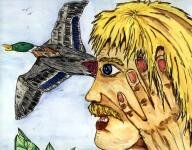
And as he prayed, all the hundreds of water-birds beat their wings against the surface and rose into the air. Circling the lake, they whooped and whistled, hooted and boomed, quacked and honked. In fact, they made such an awful noise that the Norman knights covered their ears.
But the Welsh prince didn't mind: to him it was the sweetest song in the world.
* THE END *
Copyright ValleyStream 99