On a rocky clifftop at the tip of Dyfed Patrick sat
down and thought about his previous nights dream. Once more the voice had told him to move on - the church in this valley would be built by the prayers of another holyman.
So the young Welshman, who became the future patron saint of Ireland, gazed out over the white sandy bay and across the sea to the distant Irish hills.
Thirty years later Saint Non gave birth on the same headland. Although thunder and lightning raged around her, she was bathed in sunlight, and a health-giving spring issued from the rocks at her side.
Non called her son Dewi (David in English), and even as a child he had god-given gifts. Paulinus was Davids spiritual teacher, and as he grew older his sight faded.
The lad put his hand over the blindmans eyes and blessed them. At once Paulinus could see clearly.
When he reached manhood David travelled throughout South Wales, healing the sick, the blind and the lame. He converted the people to Christianity and encouraged them to build churches.
In his day these were small wooden huts set in a llan (which means fenced-in land), and the villages of Llanddewi took their names from the churches he established.
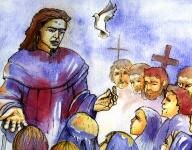
Near Tregaron David attended a gaggle of bishops, meeting to debate important questions of the day. The crowd was so noisy and boisterous, though, that their words of wisdom couldnt be heard.
Well, David was tall in height and he did have a big voice, so he laid his
handkerchief on the ground and the earth rose into a small hump beneath his bare feet. Then a white dove flew down from the heavens onto his shoulder, and he spoke to the people below with a voice that resounded like a trumpet.
The Church of Llanddewi Brefi was built on the mound which had grown up at Davids feet, and his stone staff was kept inside as a holy reminder of that day.
David founded his own church in Dyfed near Saint Patricks Bay of White Sand, and his followers lived in smaller huts closeby. Life was simple and severe for the monks because he was a gentle but firm task-master.
The monks grew their own crops and pulled the ploughs themselves instead of using oxen. Meals consisted of bread and herbs, and their leader became known as Dewi Ddyfrwr (David the Water-drinker) since that was all he drank.
One of the monks was a short nobleman from Brittany called Justinian. He was both friend and confessor to David but he sought an even more austere and isolated lifestyle.
So he retreated to the extreme end of the peninsula and hacked away the neck of land connecting it to the monastery. Only jagged rocks remained over which the sea surged.
The Island of Ramsey, which Justinian had created, was easily visited by seabirds and seals but the tossing sea made it difficult for boats. Anyway, one day 2 sailors arrived: David has fallen sick and begs your help. Can we take you across the Sound?.
The recluse agreed and stepped into the boat. Partway across, though, he became suspicious of the strange oarsmen, and he began reciting from Psalm 79: Help us, O God of our salvation, for the glory of thy name.
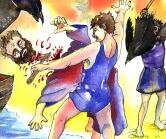
At his words the mariners turned into croaking black crows and whirled away into the stormy sky.
Justinian managed to row back to Ramsey but the devil-crows had reached it before him. They entered into his servants - who rushed out to assault him and then cut off his head.
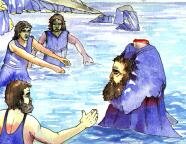
This time Justinian walked back across the sea carrying his own head - and the waves didnt bother him at all. On the mainland his friends received his spirit and buried his body with dignity.
Eventually, David built a new church nearby in the folded hills of the Alun river-valley, and he spent his life expounding the gospel of Jesus Christ. He went on a pilgrimage to Jerusalem and was confirmed as an Archbishop of Wales.
When he died, on March 1st 589, the Welsh people fasted for three days and mourned him deeply. Then the tall bones of David were mixed with the small bones of Justinian and enclosed in a chest within the church.
Ever since, Christians and kings have prayed at the shrine of the saints, two pilgrimages made to this secluded corner equalling the merit of one to Rome.
Nowadays, visitors descend from the city of St Davids to reach the Cathedral which developed on the site of his wooden church.
Over the centuries David became known as the patron saint of Wales, and for the last six hundred years March 1st has been celebrated here as St Davids Day.
* THE END *
Copyright ValleyStream 99